


Ask anyone who has tried to start a political consulting shop in the last few years and you will hear a version of the same complaint. The work is out there. The campaigns are spending more money than ever. And yet the door feels bolted. You are not imagining it. The political vendor market really has gotten harder to break into. I will show you the math.
Loyalty at the very top of the market was already locked down more than a decade ago; it has barely moved since. The front door keeps changing, cycle after cycle. Fewer new firms get in each year. The ones that do get in win a shrinking slice of the money. And when a real open competition comes along, the firms that already have billed millions win more of those than they used to. Nowhere is the story cleaner, or more surprising, than in my turf… digital.
The West is No Longer Wild
If you had to pick the corner of political work where a scrappy newcomer could break in, you would pick digital in 2010. I was that lucky, and at 50, I’m one of the oldest players in the space.
It was, for a while, a meritocracy. A land rush, and we were there for it along with a handful of other shops. Then, in the space of a decade, digital went from the most open category in American politics to one of the most closed.
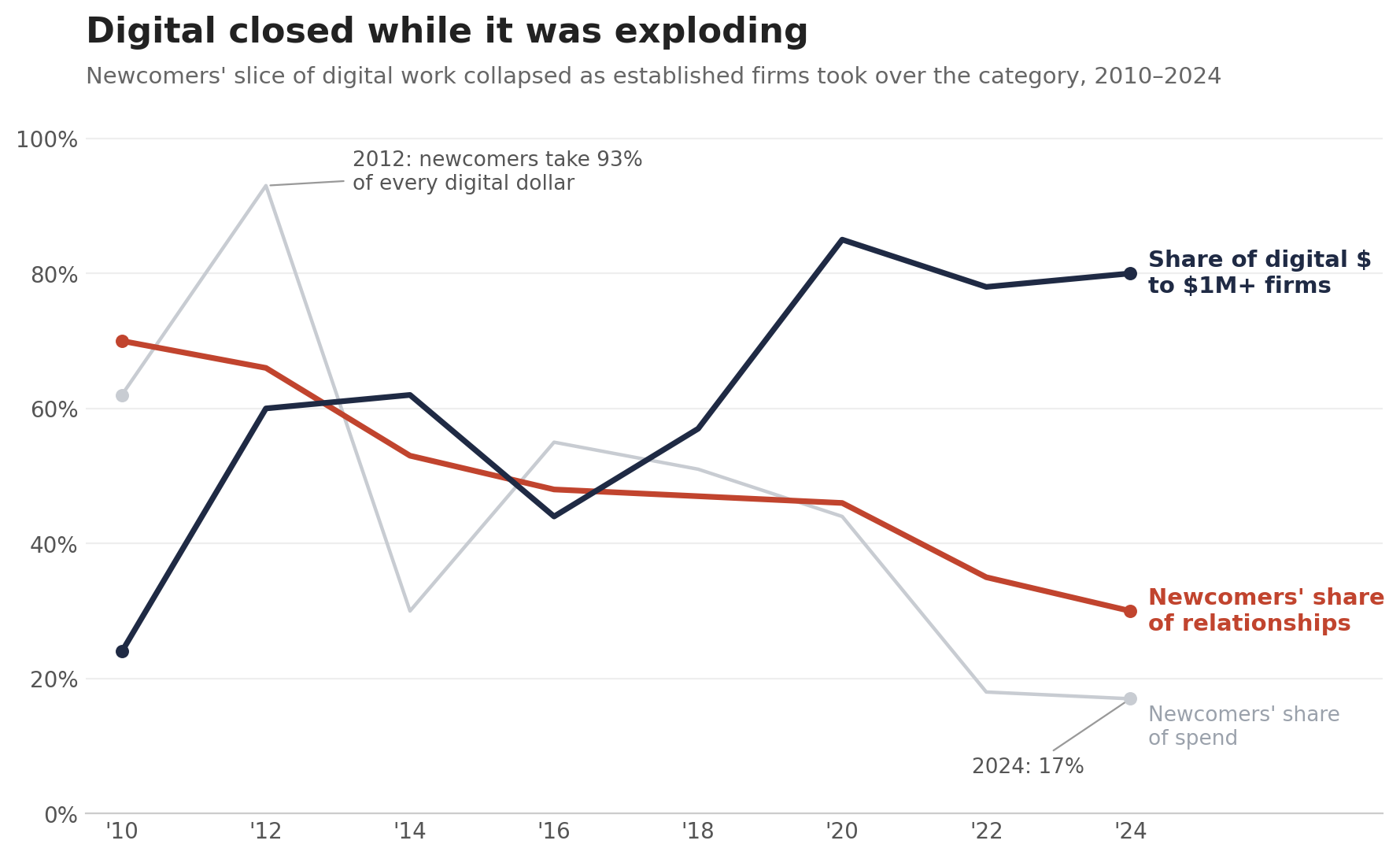
The best time to plant a tree was yesterday. The best time to enter the political market was eight cycles ago.
What makes this genuinely strange, the detail that ought to anchor the whole story, is that digital closed while it was exploding. This was a category that consolidated in the middle of its own boom. In 2010, digital was a rounding error: five identifiable vendor relationships in a thousand, two dollars in a thousand. By 2024 it accounted for 9 percent of all FEC-tracked vendor relationships. And over exactly the same stretch, the newcomers’ share of it collapsed. The pie went from small to extra large, and the number of hands allowed to touch it shrank.
More ways to see the same thing
Digital is the sharp edge, and the same hardening appears across the entire market, in seven different cuts of the data that all point the same direction.
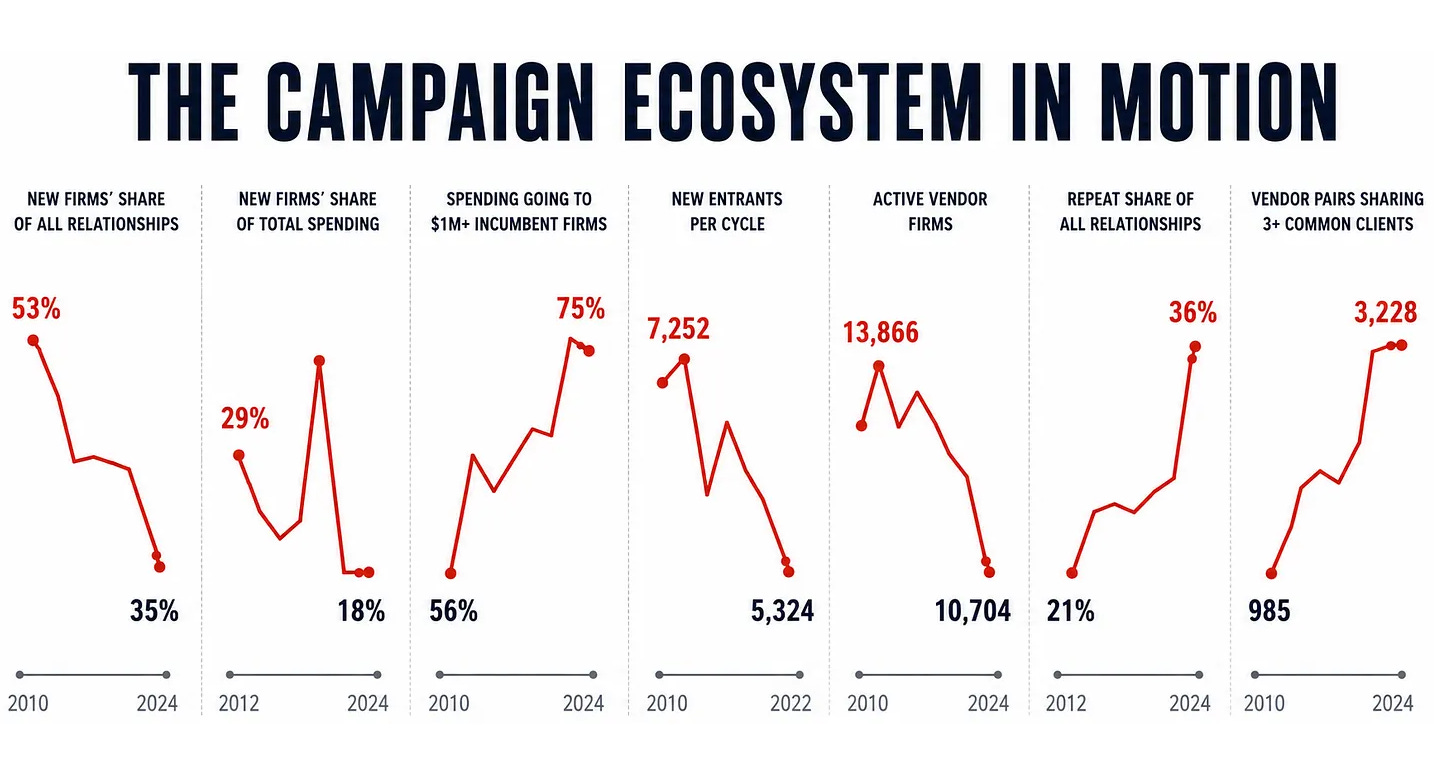
The odds of breaking in have bent hard, in one direction. Seven measurements, each built independently, tell the same story.
New firms’ share of all relationships fell from 53 to 35 percent.
New firms’ share of total spending fell from 29 to 18 percent.
Spending going to million-dollar firms rose from 56 to 75 percent.
New entrants per cycle fell from 7,252 to 5,324.
The active vendor population fell from 13,866 firms to 10,704.
Repeat relationships climbed from 21 to 36 percent of the market.
Vendor pairs sharing three or more clients more than tripled, from 985 to 3,228.
One exception runs the other way, and it proves the rule. In 2020 a single nine-figure opportunity, Mike Bloomberg’s gift to the political consultant community spiked newcomers to 42 percent of spending. Set that one committee aside and the line resumes its fall.
Incumbency throws things off. So I looked only at the genuinely open competitions: brand-new relationships, formed by campaigns that already existed and could have hired anyone. This is the contestable pool, the sliver of dollars that are up for grabs. The share of those open contests won by the largest million-dollar firms rose from 12 percent in 2012 to around 20 percent in the most recent cycles. And the contestable pool itself is shrinking, from roughly 12,500 open relationships per cycle down toward 10,000. Frankly, I am glad I entered this market in 2010.
So why does it feel harder than ever? Because it is.
It feels harder to break into the political business than ever before because, by nearly every measure, it is harder.
A new firm starting today lands a smaller share of relationships. They win a smaller share of the money. They face a higher cost of entry (in part due to contract language). They compete against a denser web of entrenched teams. Fundraising is on the same road, just driving slower: the million-dollar cohort’s share of fundraising dollars climbed from 45 percent to 71 percent over the same stretch. Part of this is the proliferation of subvending relationships, but the rest is simply the big eating the small.
What changed, and what is still changing, is everything around getting that first relationship. The number of firms that enter. The share of money they can capture. The odds that an open competition goes to someone new. The willingness and ability of first-time candidates to hire outside the party recommended vendor. The calcification is happening at the point of entry.
NOTES
New firm. I went back to 2004 and reviewed firms that received any FEC-tracked disbursement. Except where noted, a “new firm” or “entrant” in a given cycle is one whose first appearance falls in that cycle or the one before it.
Relationship. A relationship is a committee–vendor pair within a two-year cycle, collapsing all payments between them. The source is my hand-built dataset of roughly $18 billion in tracked political spending across more than 20k distinct vendors. Getting there required resolving about 200k raw name variants and mapping nearly that many vendor-to-vendor relationships, reconciled against FEC records vendor by vendor. This required some help from the robots.
Million-dollar firms. A “$1 million” or “large incumbent” firm is one with at least $1 million in cumulative FEC billings across all categories and committee types as of the prior cycle, in nominal dollars. This is a firm’s total career footprint in the data, and it is not adjusted for inflation. And remember this is just tracked political spending… it does not take into account anything else. This threshold leaves out many firms (including my own) that bill millions in non-FEC tracked business.