
This is Us
Part III

This is Part 3 of a series on the American campaign operative. (Part 1 | Part 2)
You already know you’re leaving campaign work. Or you already left. Or you’re one of the three people in America who figured out how to stay without becoming a cautionary tale. Doesn’t matter which, you all need to hear the same thing: you were part of a labor market you didn’t understand.
If You Already Left: You Made the Right Call (Probably)
Seventy to eighty percent of you bail in the first three years. You went to corporate, nonprofits, government, tech, grad school, or you’re teaching yoga in Asheville. You left because:
You got married, had a kid, and/or wanted a normal life.
Your parents said you were above this.
You watched someone on their seventh cycle earning the same as you on cycle one.
Perhaps you didn’t want to be part of it. Entrants tied to the 2016 cycle show the highest early attrition in at least twenty years. Fewer than 12% of 2016 cycle entrants reattached to a durable institution (vendor, committee, or government role) by year three, making 2016 the worst year to land a long term job in politics. By comparison, operatives entering the system between 2008 and 2012 reattached to campaigns at roughly 18–22% by year three. The collapse wasn’t gradual.
Most of that is because the numerator increased as the presidential platforms pivoted and attracted fresh blood. But there were no extra jobs.
High turnover isn’t a bug, it’s the business model. When most people exit before year three, no one accumulates the seniority that would force higher pay. So why do you still check your empty inbox at 2am feeling like a quitter? Why the FOMO, years after you were done with 5am donut runs and buying clipboards at Staples at 8pm on a Saturday. It’s not the loss of adrenaline; it’s because they convinced you that leaving campaigns meant leaving politics.
That is a lie.
Here’s what actually happened: You entered through a single network. A state party, a training program, a committee internship. That network gave you exactly one pathway. When that pathway didn’t scale financially, you left.
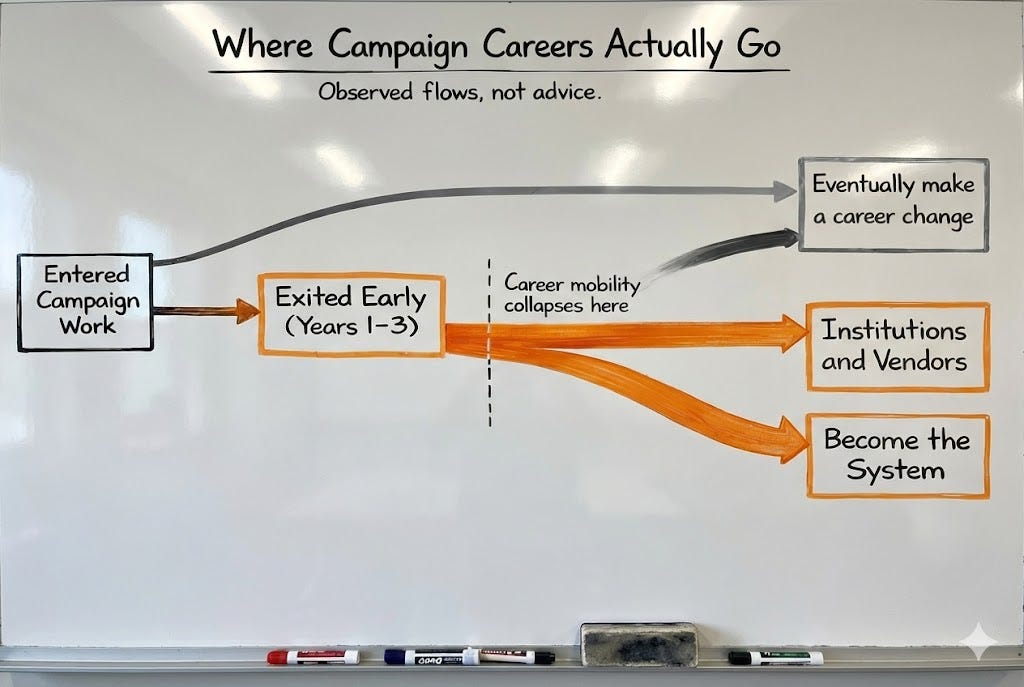
There’s a moment most operatives don’t recognize until it’s already passed: the point where your career stops behaving the way you were told it would. Early on, movement is cheap. You can leave, pivot, re-enter, switch networks with little penalty. But each cycle reduces your velocity. Titles accumulate, expectations harden, your network narrows. By year six, exits don’t fail because you lack talent. Exits fail because the ladder is broken. There is another job for you, but it’s the same job you just had.
If You’re Still In: Stop Climbing the Broken Ladder
There is no ladder, not anymore. What you’re climbing is a treadmill painted to look like stairs. The data is absolutely clear on this: seven-year veterans make roughly what second-year managers make. Experience doesn’t compound financially, it compounds structurally through your network. Your value is your network, not your 401k. If you’re staying for a while, you become a low priest of democracy: less wealth, more obligations, and a flock to tend to.
Your Real Options (Pick One on Purpose)
The roads diverge in your 20s and 30s. You will choose one of three and it will make all the difference.
Option 1: Build a Portfolio, Not a Resume
Work in multiple states. Build relationships with party committees, independent expenditures, consulting firms, and advocacy groups. Become the person who knows how Ohio and Arizona and Georgia work. Get out of the 3/4 of states in America that are political operative gravity wells. Become the bridge between campaigns and vendors, not the just vendor’s person on the ground. This requires:
Renting your home
Treating every campaign as a networking opportunity
Saying no to the bigger race if it doesn’t expand your network
Eventually monetizing your network instead of your hours
You’re building a web, not climbing a ladder. Nobody tells you this at 22.
Option 2: Get Off the Bus, But Stay in the Ecosystem
Become a chief of staff. Join a party committee permanently. Find a vendor you like. Work in government or near it. Find an institution that survives election cycles and attach to it before you’re too expensive to hire.
This is the exit for most of you. Real salaries. Health insurance. You can buy a house before you’re 45. You’re still in politics, but you’re shredding your soul every two years.
State party-related political work comes with a catch: These positions aren’t evenly distributed. Some state parties actually build careers. They’re more often Republican, competitive, and medium sized (Tennessee, Florida, Pennsylvania). Others just produce years of reliable labor with no ladder, especially in states with more idealistic 22 year olds than campaign jobs.
You don’t need a fancy degree to understand how supply and demand work. In New York, you are labor. In Georgia, you are the talent.
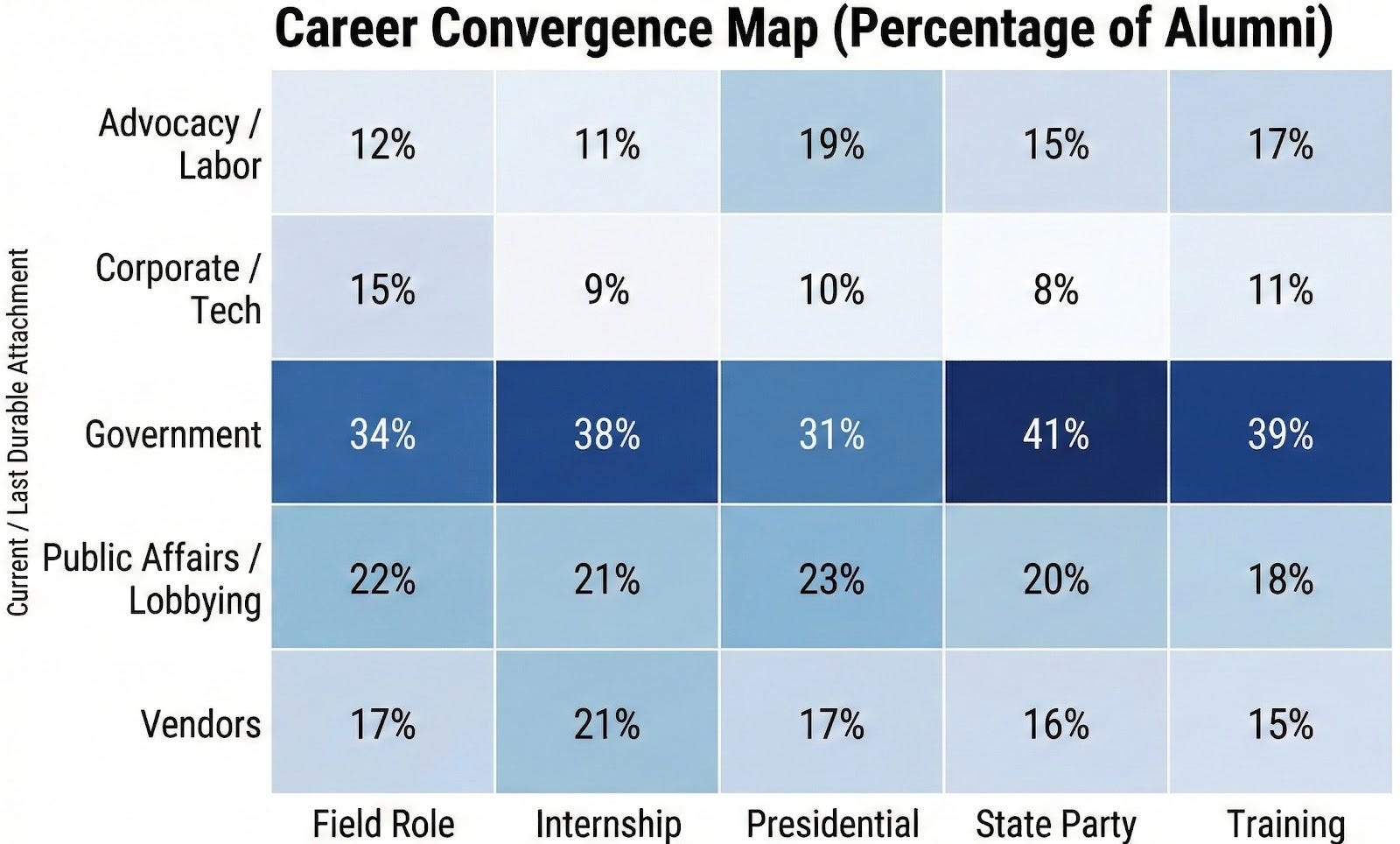
Where you attach determines whether you’re building infrastructure or just surviving. Choose carefully.
Option 3: Stay Home and Become the System
Plant roots in one state. Become the person everyone calls. Know every county chair, every donor’s quirks, every consultant’s secrets. Train the next generation when there is one.
You won’t get rich. You won’t get raises. You’ll take the races nobody wants, carry the weight nobody sees, and watch people half as competent get twice the credit.
But you will have access to power. You’ll be essential. There’s no LinkedIn category for this. You just own the phone that rings when something has to get done. The people on this path aren’t naive. They know what they’re giving up.
The Quiet Part Out Loud
Some of you reading this ran your first race in a storefront office where volunteers might stroll in. You remember pizza grease and toner, the wall of binders, learning field ops by watching someone do it wrong first. You met your future spouse at that conference table in someone’s unfinished basement. For those of you of a certain age, a fax machine and comically large copier.
Your kids will never know what it felt like to be in the room.
When the room disappeared, campaigns stopped being places you entered and became something you logged into. The office staff who learned to keep the machine running got replaced by someone who knew how to boost a Facebook post. The physical infrastructure collapsed while we were all posting through it.
What Happens Next
No one is coming to fix a broken labor market. There will be no compensation reform, no structural reinvestment, no apprenticeship renaissance. The 2016-2024 cohort faces the most severe institutional deficit in modern history. Field operations collapsed 80-90%. The committee-to-campaign pipeline contracted. Digital roles turned over so fast that the average Digital Director tenure is 1.5 years.
We had 400 applicants for a recent opening. Something changed. Doc Sweitzer, one of my favorite grey beards, gives a talk to college classes that basically says: There are no jobs for you.
The data shows he’s right: generational timing predicts survival better than party, geography, education, or talent. I entered in 1998 and therefore have nearly 4x the survival probability of someone who entered in 2020. That’s not because I’m tougher. It’s because I entered when the room still existed, when committees hired from campaigns, when 84% of entrants came through actual campaign work with field experience.
By mid-career, the data shows alumni sort less by party than by ideology: public affairs, government, vendors, infrastructure, or exit. Party identity fades but the invisible string connecting alumni doesn’t. What remains is where you managed to attach before career mobility collapsed. We are not the same people. But we are sorted the same way.
This is How it Ends.
If you left: Stop feeling guilty. You were under no obligation to stay.
If you’re staying: Pick your endgame, don’t let it pick you. Build your network like it’s your actual job. Your path is to become a low priest of democracy. This is how it ends.

Spot on, Jordan. That 'collapse' in mobility is the direct result of campaigns being built to dissolve rather than develop. Without professionalized HR and systems, talented staff are treated as disposable fuel instead of long-term assets. Professionalizing the 'invisible' side of the campaign is the only way to turn that sorting system back into a ladder.